

It should come as no surprise that being overweight or obese is unhealthy for our canine companions and indeed this is confirmed by a new study, which showed that overweight dogs do not live as long as dogs of healthy weight. The study, conducted by the University of Liverpool and the Waltham Centre for Pet Nutrition, used data provided by Banfield Pet Hospital to review the life spans of 50,787 middle-aged dogs of 12 different breeds. Researchers examined information provided Not surprisingly, the researchers found that the overweight dogs lived up to two-and-a-half years less than dogs of ideal body weight. That’s a big chunk of a dog’s life. Consider that for a dog with an average expected lifespan of 14 years, chopping two-and-a-half years off reduces the dog’s life by 18%.
According to study co-author Alex German, Professor of Small Animal Medicine at the University of Liverpool, overweight pets are predisposed to a variety of chronic health issues, including joint disease, respiratory issues and even certain types of cancer.
According to the Association for Pet Obesity Prevention, in 2017 an estimated 56% of dogs (and 60% of cats) were overweight or obese.
While we don’t have control over everything in our lives or our dog’s lives, weight is one of the factors that in large part we can control. This is especially true given that the situation of overweight in companion animals is caused largely by lifestyle and nutrition factors, not by medical issues.
Don’t we owe it to our dogs to feed them for a healthy weight, bestowing them the gift to enjoy their longest life possible? I certainly believe we do!
And you know what? Feeding a plant-based diet is an excellent way to help your dog achieve a healthy weight and stay fit and trim for life!
Vegan diets for weight loss have not been clinically studied in dogs (after all, studies take money and what mass-market commercial pet food company with deep pockets would want to promote a vegan diet?), however they have been studied in people and fortunately there are close genomic comparisons between us and our canine companions.
A 2016 randomized controlled trial showed that people who eat a vegan diet (no animal products at all), had a lower Body Mass Index (BMI) and more significant weight loss at the end of six months than people who ate other types of diets: omnivorous (the control group), vegetarian, semi-vegetarian or pescatarian. According to the researchers, the vegan group’s weight loss was “significantly different” (lower) than the other groups.
A 2016 review of 96 studies of vegan and vegetarian diets also concluded that plant-based diets were better for weight loss than omnivorous diets.
Achieving greater weight loss on a plant-based diet compared to diets that contain animal ingredients makes perfect sense. First of all, animal products typically contain high amounts of fat, and predominantly saturated fat. Since fat contains more than twice as many calories per the same amount of food as protein or carbohydrates, consuming higher-fat foods will more quickly pack on the pounds. Indeed, the vegan participants in the 2016 randomized trial decreased their total fat and saturated fat more than the other groups. And, very interestingly, the study also found that vegan diets improve macronutrients (protein, fat and carbohydrates) more than the other types of diets.
Plant-based diets are also higher in fiber, which promotes a sense of fullness without packing on calories. This is why commercially-based weight loss diets for dogs are higher in fiber.
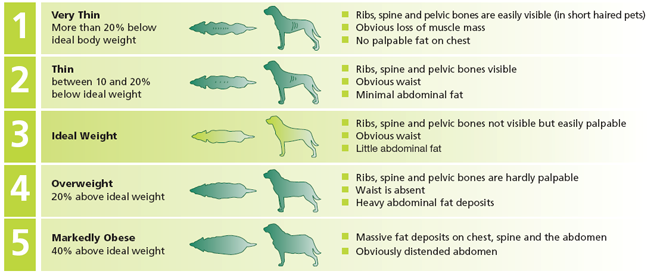
The following chart will help you to determine whether your dog is overweight based on his/her Body Composition Score (BCS):
But plant-based diets don’t just facilitate healthier weight; they are also found to contain many other health benefits, including:
- Reductions in incidence and/or mortality from Ischemic heart disease (mini stroke).
- Significant reduction of cancer (-15%).
- Reduced inflammation.
- Decreased risk of cataracts.
If your canine companion could benefit from trimming a few pounds, or if you just want to ensure that he or she maintains and ideal weight, I recommend trying a nutritious, balanced plant-based diet. Not only will your dog live longer from being a healthy weight, but he or she will also reap the many other health rewards of consuming a diet rich in plants, including reduced risk of cancer!
Just remember, as with any type of diet, you always want to be sure you are feeding a balanced diet. I formulate balanced plant-based diets for clients all over the world and am happy to help! I also highly recommend this book by Dr. Richard Pitcairn, which contains wonderful, balanced plant-based diets.