

If your dog has been diagnosed with chronic kidney disease, you might feel confused or even scared. I get it. I’ve been formulating custom homemade recipes for chronic kidney disease (CKD) in dogs for many years. Previously, I created meat-based diets for dogs with CKD. But in 2018 I learned that a plant-based diet is best for these dogs (and for all animals and the planet!). In fact, I dedicated an entire chapter in my book, The Plant-Powered Dog, to showing exactly why a properly-formulated plant-based diet for kidney disease in dogs is far superior to one based on animal ingredients. In this post, I’m going to touch on some of the key points from the book, so you can decide for yourself the nutritional approach you want to use with your canine companion.
Myths About Plant-Based Diets for CKD
Has your veterinarian told you that dogs with CKD shouldn’t consume a plant-based diet? If so, I’m not surprised because I hear that a lot in my practice. Here are some of the common objections cited:
- Grains and legumes are too high in phosphorus.
- Dogs need ‘highly digestible’ protein (i.e., meat).
- Dogs can’t get all the nutrients they need on plant-based diets (that objection conveniently covers every situation).
Interestingly, people with chronic kidney disease may very well hear these same objections from their medical doctors.
But is this information correct? No. It’s isn’t. In fact, it’s quite the opposite.
A 2016 observational study of 14,866 people with CKD published in the American Journal of Kidney Diseases demonstrated that those who get more of their protein from plants have a lower risk of death from all causes than those who get their protein from animal sources. The authors concluded that, “this study suggests that a higher proportion of protein from plant sources is associated with lower mortality in CKD patients.”
But can this information also apply to dogs? Absolutely. Here’s why:
- Our dogs’ kidneys function the same as our own.
- Dogs have the same symptoms, biomarkers and complications as people.
- People and dogs are prescribed the same medications and follow the same nutritional guidelines.
- Chronic kidney disease in dogs and people progress in a parallel manner.
The Kidneys – A Key Detoxifier
In a moment, we’ll compare plant-based vs. animal-based diets for chronic kidney disease in dogs. But first, let’s do a quick rundown on the important role the kidneys play in the body’s detoxification process.
Waste removal begins in the liver. Everything we consume passes through the digestive tract to the liver via the hepatic portal vein. The liver acts as a security guard whose job is to keep the ‘bad guys’ from entering the circulatory system, while letting the ‘good guys’ pass through. ‘Good guys’ such as dietary nutrients are sent directly to the circulatory system for immediate use or are stored in the liver for future needs.
The liver does what it can to detoxify ‘bad guys’ such as drugs, chemicals, bacteria, viruses and fungi. It also converts ammonia, a toxic byproduct of protein metabolism, into less toxic urea. When the liver finishes breaking down these toxic products, it filters the byproducts to either the bile or the blood. Waste sent to bile passes through the intestines and is eliminated from the body in feces. Waste passed into blood is sent to the kidneys, which excrete them via urine. In this way, the kidneys play a vital role in eliminated toxins and waste from the body.
Dietary Comparison for CKD in Dogs
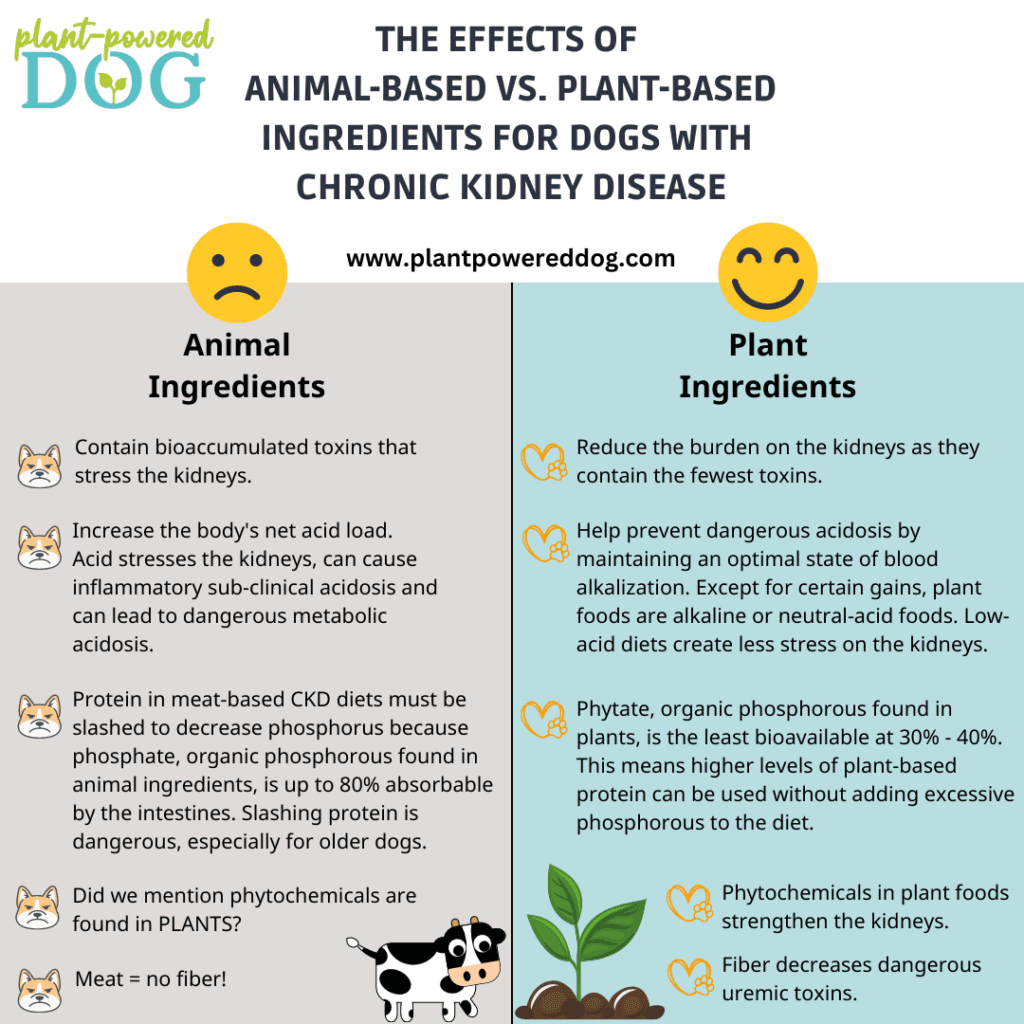
Now, let’s take a look at how plant-based and animal ingredients affect the kidneys. For this purpose, I’ve created a concise (and shareable!) graphic to present a clear side-by-side comparison.
What About Commercial CKD Diets?
If your dogs suffers from signs of chronic kidney disease, your veterinarian will likely refer you to one of the specially-formulated commercial CKD diets. These diets are formulated with the proper nutritional levels in mind. But are they really supportive of your dog’s kidney health (or health in general)?
Let’s take a look at the ingredients in one of these very popular “kidney care” products:
Brown Rice, Brewers Rice, Pork Fat, Cracked Pearled Barley, Chicken, Egg Product, Dried Beet Pulp, Whole Grain Sorghum, Corn Gluten Meal, Chicken Liver Flavor, Soybean Oil, Fish Oil, Calcium Carbonate, Lactic Acid, L-Lysine, Pork Liver Flavor, Potassium Chloride, Potassium Citrate, DL-Methionine, vitamins (Vitamin E Supplement, L-Ascorbyl-2-Polyphosphate (source of Vitamin C), Niacin Supplement, Thiamine Mononitrate, Pyridoxine Hydrochloride, Calcium Pantothenate, Riboflavin Supplement, Vitamin A Supplement, Vitamin B12 Supplement, Biotin, Folic Acid, Vitamin D3 Supplement), L-Threonine, Choline Chloride, Iodized Salt, Taurine, Magnesium Oxide, minerals (Ferrous Sulfate, Zinc Oxide, Copper Sulfate, Manganous Oxide, Calcium Iodate, Sodium Selenite), L-Carnitine, L-Tryptophan, Mixed Tocopherols for freshness, Natural Flavors, Beta-Carotene.
The first ingredient in this recipe is brown rice. Brown rice is high in inorganic arsenic, which is a known carcinogen and particularly dangerous with chronic exposure. Since the kidneys filter out toxins, it’s obviously not a good idea to feed a daily dose of a food known to contain high levels of a toxin. This can place unnecessary burden on the kidneys, as well as expose dogs with CKD to additional health issues, including cancer.
In addition to brown rice, this product contains barley, sorghum and corn gluten meal. So, what’s the problem with these ingredients? Grains in pet foods can contain mycotoxins such as aflatoxins and fumonisins, which are highly dangerous toxins produced by certain molds. As told by a specialist to Pet Food Processing:
“Aflatoxins are amongst the most poisonous mycotoxins and a serious threat to both human and animal health,” said Lars Povlsen, global sales manager of proteins for TOMRA Food, a Norwegian company specializing in sensor-based sorting and processing technologies for food, including pet foods.
There is no sure-fire growing condition to prevent all molds on grains. Some mycotoxins thrive in drier weather, while others prefer moisture. Also, mycotoxins are very hardy and stand up to processing, so it’s critical to test and eliminate tainted grains before they enter the production stage. Mycotoxins can also develop after pet foods are packaged. This is a particular risk with dry foods and treats sold in bags.
Long-term exposure to mycotoxins can cause a variety of serious health issues, including immune system problems, liver damage and cancers.
But the grains aren’t the only problem with this product.
The soybean oil is also concerning. It’s highly likely that this oil is produced from genetically modified (GMO) soybeans. GMO soy is designed to be highly resistant to pesticides and herbicides such as RoundUp (glyphosate), the weed killer from Monsanto (now Bayer). In 2015, the International Agency for Research on Cancer (IARC), an arm of the World Health Organization (WHO), formally classified RoundUp as a “probable carcinogen.” In response, many countries have enacted national legislation to ban glyphosate at some level—but so far, the United States is not among them.
I could go on about other ingredients in this food as well, including probable artificial ingredients in the “chicken liver flavor” and “pork liver flavor”, unspecified “natural flavors” and even the fish oil (mercury?).
So, again, we have to ask the question: Since the kidneys play a key role in filtering out toxins, then why would we want to create an extra burden on them by feeding ingredients that may contain toxins?
Bottom Line
If anyone tells you that plant-based ingredients are bad for chronic kidney disease in dogs, please be sure to do your own research. For all the reasons I just discussed, and many others, a nutritionally appropriate plant-based diet can help reduce dietary toxins, lower the body’s net acid load, decrease uremic toxins, fight cellular oxidation, decrease inflammation and provide a host of beneficial nutrients that support optimum kidney health.
Be aware, however, that even a nutritious plant-based diet must be properly formulated to address the specific nutritional needs of dogs with CKD. I specialize in creating custom diets for chronic kidney disease in dogs. My professionally formulated recipes meet the latest dietary recommendations and mirror the nutrient levels found in the famous “prescription” CKD diets. The difference is that my recipes are based on 100% whole, fresh plant foods that kidneys love!
Interested in learning how I can help your dog with CKD? Let’s talk.
And don’t forgot to grab your copy of my newest book, The Plant-Powered Dog: Unleash the healing powers of a whole-food plant-based diet to help your canine companion enjoy a healthier, longer life. The book contains an entire chapter on chronic kidney disease in dogs, as well as chapters devoted to a plant-based approach to other common canine chronic inflammatory conditions, including cancer.
